Archive for category Uncategorized
Is Google Street View Photojournalism?
Posted by Kevin Moloney in Digital, Ethics, Practice, Uncategorized on February 13, 2011

Site © World Press Photo. Images © by whom?
This year in the World Press Photo Awards an honorable mention was awarded to Michael Wolf, a prior World Press award-winner from Germany. Wolf’s entry this year was for a series of photographs made of the screen of his computer as he explored Google’s Street View, a service in which automated cameras mounted on vehicles trawl the world to present the street in virtual space.
The debate over the award (as is often the case with World Press Photo) is interesting to read.
The criticisms ring with complaints that they are not his pictures, that it wasn’t him standing there slicing those moments from time, that he’s not out in the world struggling with the rest of us.
These criticisms are a bit navel-gazing in that they are mostly about how we define ourselves as photojournalists, not in how we define what photojournalism does. The boys at dvafoto have an excellent post on these points. You can see Wolf’s comments and thinking in an interview in the British Journal of Photography.
Photojournalism (and photography in general) has a long history of overvaluing process when the only thing that matters is the result. What really matters to the reader? The process or the picture? The complaints smell a bit of “you took the easy way out.” That’s not a legitimate argument.
I don’t specifically care that Wolf chose to use the automated, surveillant and serendipitous cameras of Google. I also would not care had he used screen grab software rather than a camera to make the pictures. Using the camera here just smells of a strange justification and trying to find a way to make himself the photographer. The result is the same as a cropped screen grab but with lower quality. And as others have pointed out, screen grabs from surveillance cameras or TV have been published alongside what we consider “real photojournalism” for a very long time. (A notable difference is that these sorts of images have not won photojournalism awards in the past that I know of. Correct me in comments if I’m wrong.)
Wolf’s collection of images is fascinating, powerful, opinionated, curious and somewhat addictive. I like them very much. They are art as Girl Talk’s remixes or John Cage’s Chance Music are art. But they are not photojournalism. By presenting this work with a venerable photojournalism award, the World Press Photo jurors have declared them photojournalism, even when Wolf himself apparently does not.
My argument against these images as photojournalism is over the lack of context. As photojournalists we all know how critical it is not only to understand how an image we make or publish would be read, but also what the circumstances are surrounding those images so we can correctly inform the reader. We’ve all made photos sliced out of air that without context might mean something entirely different than the story we were there to tell. In our outtakes we all have images that might accidentally lie, and as photojournalists we have the responsibility to make sure those don’t see the light of day as journalism.
What is happening in these images? We can assume, but we cannot know. Wolf can assume, but he cannot know. He was not there to see the moment unfold and interpret its meaning. He could not follow up with the subjects to clarify what just happened.
Wolf uses the term “curate” to describe these images, and I think that is closer, but still not correct. He is collecting things out of context and interpreting them from personal experience, but not the background information. A curator has context and background from the maker of the images. Wolf lacks even that. An editor of photojournalism should also gather the background and context from the photographer/witness before publishing. Wolf can’t (realistically) do that either.
Our job is an imperfect one. We inevitably contextualize important events through the filters of our own eyes, our own lives and our own experiences. But we should do the same through the objective circumstances of the scene. It is the valiant effort to understand the scenes we photograph that makes us journalists. It is not the process we use to capture the images.
World Press Photo’s jurors surely knew this would be a controversial award. I find nothing wrong with Wolf’s work other than the label put on it by the jurors of the contest and by Wolf in entering it there. There are many appropriate venues and labels for “A Series of Unfortunate Events,” but Press Photo is not one.
Fame is Narrative
Posted by Kevin Moloney in Audience, Industry, Uncategorized on January 4, 2011

Photo by Vivian Maier, Linked from http://vivianmaier.blogspot.com/
What makes the difference between a recognized artist and a dabbler, an amateur or a dilettante?
I am sure there are formulas, Ph.D. dissertations and many entire books on the subject. I’m not writing this as an expert, only an observer.
And I’ve been observing the case of Vivian Maier, a long-time amateur street photographer whose work was only discovered by accident in 2007 and attributed to her shortly after her death in 2009. Her images were uncovered by a few auction buyers who purchased her negatives and found themselves intrigued by the images. Through their efforts her work has since been published in blogs and international publications and exhibited by museums.

Photo by Vivian Maier, Linked from http://vivianmaier.blogspot.com/
Much of what makes the work compelling is the story behind it — a reclusive and private nanny who never really shared her images and found recognition only after the end of an austere life.
That could be tragic. We all want to know in our own lifetime how our work is received. But then again she appears to have intentionally stayed out of sight. Maybe the tragedy is that we have thrust an intensely private person into the spotlight with our admiration.
Tragedy (and overcoming it) makes a powerful narrative. And that narrative, as much as her work, is what is propelling Maier onto the world stage as an artist. Other tragic photojournalism figures have caught our attention this way, from Robert Capa’s companion Gerda Taro to João Silva. Capa, Chim and Werner Bischof have tragic narratives in tandem with their great images. The story of young Dan Eldon’s death in Somalia would have lingered in our hearts and minds for a relatively brief amount of time. But he left behind his own narrative journals, and those were aired by his mother and sister in an excellent documentary on conflict photographers.
Drama isn’t the only propeller of narrative, though. Character plays an important part too. It’s very hard to think of a canonized artist who was not a great character. Georgia O’Keefe, for example, caught the public’s attention intensely after her work was interpreted as sensual or sexual despite her objections. With that interpretation, she became a character in the art world and more famous as a result. Then after moving to New Mexico in the 1940s she created an entirely new character of the reclusive desert artist. Rarely is her work seen without either persona in mind by the viewer.
When we decide to become photojournalists we are often choosing a character already — one of a world-traveling bon vivant as Andre Friedman and Gerta Pohorylle created in the invention of Capa and Taro. Or we imagine ourselves grizzled war correspondents like Ernie Pyle, artful cowboys like Bill Allard, sensitive investigators like Donna Ferrato, or artists of the ephemeral like Sylvia Plachy or Martine Franck.
Of course art is important. No amount of character can be made up for (for long at least) by a lack of talent. This brings me back to Vivian Maier. In a very recent article in Chicago Magazine, Colin Westerbeck, a former curator of photography at the Art Institute of Chicago and coauthor of an outstanding tome on street photography, said in an interview, “She worked the streets in a savvy way,” he says. “But when you consider the level of street photography happening in Chicago in the fifties and sixties, she doesn’t stand out.”
No, she doesn’t. The work is familiar even where it is compelling. It lacks, perhaps, the higher purposes of academic art where the artist strives for a statement, an irony, a challenge that may only be evident to academics or those who bothered to read the analytical preface of the book. In addition, she cannot control how the work is being edited now, so we see her gems mixed with frames she might have discarded.
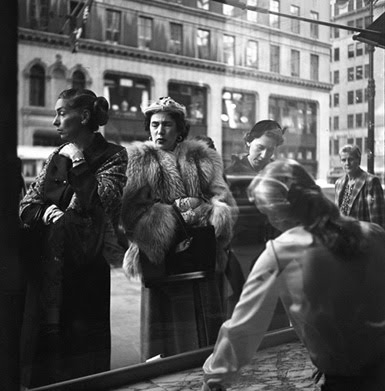
Photo by Vivian Maier, Linked from http://vivianmaier.blogspot.com/
I believe Maier’s work is art because of its absolute purity. I’ve been watching her images appear on John Maloof’s blog since before her fascinating narrative began to unfold, and they had me from the start. Hers is the work of an artist who worked only for her own satisfaction. The opinion of friends, relatives, editors or critics was never sought. The images are wonderful because they are done only for her personal pleasure, yet they still surpass the work of a million other amateurs working contemporaneously.
Yes, she is an artist with a great narrative.
As much as we would hope our being defined as “artists” is a result of our work alone, the art is only a sliver of the formula. What is accepted as art and who is defined as an artist is as much about marketing our narratives as it is about anything else.
In marketing that narrative we must also craft our work to the expectations of the critics, the editors and collectors who will buy it, or the academic analysts who will deconstruct it.
For ourselves, though, we need to stay pure and chase what intrigues and satisfies ourselves — all those others be damned — as Vivian Maier did.
###
You can help support John Maloof and Anthony Rydzon in their efforts to make a documentary film of Maier’s life at Kickstarter.com.
It’s not really thankless job afterall.
Posted by Kevin Moloney in Audience, Uncategorized on November 5, 2010

Sonya Robison, of rural Yoder, Colo., was attacked in 2006 at home and missed a couple of payments while deciding whether to abandon the home because of her trauma. She decided to stay, and negotiated a repayment plan with her servicer. Though Robison was current on payments, she went away for Christmas and returned to find the locks changed and the house "winterized." The electricity, gas, and water supply were all turned off. The servicer said it was a mistake, and they would cover the costs of turning everything back on. She suggested she just skip one payment. By the time she made the next payment, they sent it back and initiated foreclosure proceedings. But it turns out the party that's filed the foreclosure does not appear on any deed or note. She is suing the bank. © Kevin Moloney, 2010
Aspects of the journalism profession can seem lonely. Though we meet an endless stream of interesting and compelling people in our reporting, connection to our readers, viewers or listeners is mostly one-way. And though we now have comment sections on publication Web sites, those comments are rarely about our craft and even more rarely about the photographs. Comments tend overwhelmingly to be critical of the subject matter or the others who bother to comment.
I’ve always wondered what reaction my pictures might have, both for telling a story and for their craft.
Then yesterday I received one of the most charming phone calls of my career. An 88-year-old Washingtonian was compelled by an image I made to write a letter to the editor at the New York Times. And better yet, he sleuthed out my phone number and called me to read it to me over the phone.
The smile has yet to leave my face.
The letter:
Letters to the Editor
The New York Times
620 Eighth Avenue
New York, N.Y. 10018RE: New York Times October 28, 2010 Business Page 1
Dear Sir: On the Times October 28 Business page is shown a photo by Kevin Moloney placed above a report on Housing Foreclosures.
This photo captures all the elements of an Edward Hopper painting of his late 1920’s period.
Looking into two windows of a house we see a seated woman before the left window – with a dim light on her coming through the window curtains. On her left is a brown desk or bureau with a small red object on top and the four rear window-panes provide photographic balance to the sitting figure.
The face of the young lady half in shadow, half in light evidences isolation, loneliness as well as sadness.
Turning to the adjoining apartment we see that the window is shut and the dimly lit room contains a bureau, with a green plant and an empty chair with curtains drawn. Our sight of the empty room with no person present emphasizes the isolation of the young lady in the adjoining room. The red object resting on the bureau in her room balances the green plant on the bureau in the adjoining room.
From the outside, the two windows are framed in a blue paint line and both windows are united into a central panel by a flat surrounding black wooden frame. The photographic portrayal of the isolated individual in her dimly lit surroundings reminds one of a Hopper painting.
Yours sincerely,
William R. Haley**As a graduate of Princeton ’45 I have had a continuing interest in art. In 1990 I endowed the James F. Haley Lecture Series at Princeton. The speaker earlier this year was the Director of the Museum of Modern Art.
Thank you Mr. Haley.
The Importance of Being Present
Posted by Kevin Moloney in Practice, Professionalism, Uncategorized on October 25, 2010

A days-old portrait for the New York Times. Know your subject's story and feel it with them. © Kevin Moloney, 2010.
I was walking on a beach in northeastern Brazil several years ago, taking a few hours break from an assignment there for the New York Times. I was in the middle of a rough patch in my personal life and the stream of thoughts and imagined conversations was rolling so fast I actually forgot where I was and what I was doing.
I stopped, looked down at the sand, and watched — straining to turn off that stream of words and just see what was below my feet. I was in an amazing place, covering a wonderful story. And I was forgetting to be there and savor it.
When I let my thoughts return, it wasn’t about what was happening in my personal life. I realized that my images — whether personal or professional — were much more successful when I had been truly emotionally and personally present in the scene I was photographing.
We work in a medium that can either engage us with a subject in an intimate way or separate us from our subjects with a big mechanical device to hide behind.
There are several ways we should come out from behind that camera to be present.
That old photojournalism dictum of “250 at f/8 and be there” always applies of course. We do our jobs by getting to the scene above all other considerations.

Cattlemen's Rodeo, Okeechobee, Fla. Awareness and lack of distraction help your attention and with catching a complex moment. © Kevin Moloney, 1992.
But if we are mentally present — really seeing the subject — our compositions are better. If you are struggling to understand how Richard Kalvar constructs so many complex layers of action from a single fleeting moment or how Stephen Crowley sees amusing irony around him, then try to stop that inner narrative and just watch every corner of the frame.
We should also be present with our subjects as something of a collaborator.
It’s easy in an emotional scene to hide behind the camera and burst forth with streams of motor-driven frames as the key emotional moments reveal themselves. Those pictures can even be quite impressive. But few would say that this one-sided interaction with a subject is not predatory.

Sgt. Maj. Brenda Hoster sheds a tear as she describes her boot camp drill sergeant and how that woman influenced her life. Hoster was suing the top-ranked enlisted man in the U.S. Army for sexual harassment. After talking quietly to her about her ordeal, I feel this picture was given to me rather than taken from her. © Kevin Moloney, 1997.
I once watched an intern for a local paper bound up to within inches of a crying subject who had just learned she and her family would not be receiving government aid for health problems resulting from work in a nuclear weapons plant. His pictures certainly conveyed emotion to the paper’s readers. But all the other photographers present wanted to chase him out of the room for wrecking the intimacy we had gently tried to build with the subjects.
No matter how we would like to be flies on a wall, we never are. We are the biggest presence in the room and almost always work with tacit cooperation of subjects. When we have that cooperation and intimacy, our pictures are more true, and the subjects take away with them a sense that we were there to understand them rather than just use them.

Another days-old portrait of a generous and sympathetic subject. Ease them into the situation that intrigues you. Be aware or your own preconceptions about the person and how that may alter how the reader sees them. We are ostensibly telling their story, not ours. © Kevin Moloney, 2010.
We also need to be present to understand ourselves and what we bring to that collaboration. Our mental state matters in how we see a subject, what we understand of that person, place or event, and what about it we relate to our readers.
Though true objectivity is impossible, we gain the trust of our readers by making the best, most valiant attempt to see a subject clearly. And when I leave my own baggage at home, my subjects let me deeper into their lives.
And lastly, we work in an amazing profession that takes us into the homes, offices and lives of fascinating people, to locations most only dream of visiting, and into the rarely seen inner workings of the world. Be present and enjoy it. Put down your camera and absorb where you are or who that person in front of you is.
If you seek in your images the complexity of Cartier-Bresson or Kalvar, the emotional intimacy of Krisanne Johnson or Paolo Pellegrin, the spiritual metaphor of Kathryn Cook or Michael Ackerman, or the joy and humor of Elliot Erwitt, then be there — 250 at f/8 or not.
Remember that you are here, now, and wherever or whatever that place is, you are exceptionally lucky and you may never get back there.

On the Niger River, Mali. Savor the incredible moments this profession brings you. © Kevin Moloney, 2008.
—-
The following is a journal entry I love, from a day at the beginning of my freelance career in which I left the camera at home, stopped to breathe-in the streets of Rio de Janeiro, and just watch. I smiled at the cinematic little ballet happening in front of me, glad for a change to not be distracted by trying to photograph it:
July 14, 1995
I stood at a corner in my neighborhood of Flamengo today, leaning for a moment against one of thousands of one-meter-tall concrete obelisks that line the sidewalks here to prevent space-frustrated drivers from parking their cars in the path of the wretched pedestrians.
I watched people pass.
Around the corner a woman begged, cradling a child on a blanket while her son of perhaps four years skipped among the pedestrians asking for a “trocadinho” — a bit of change.
An ancient woman struggled across Rua Senador Vergueiro on small deformed legs. She planted the cane carefully in front of herself and pried her way across the street with it. Half-way across, the light changed against her, but she held to her lever.
Impatient horns erupted from the line of cars who waited for her to move. The other cars, view blocked, honked at a cabby who defended himself with high-fisted protests. He waved back to the impatient to signal his innocence.
A tall, chivalrous-as-only-a-gentleman-can-be, old man with polar white hair and neat yellow pants rushed out and took her arm. They walked together like they were propping each other. The moment she cleared the cabby’s path by a hair he blasted forward around her.
The chivalrous old man deposited her on the other side of the street, and took the arm of yet another elderly woman. He helped her across the street in the opposite direction and kept going with her. I thought she must be his wife until she yanked herself loose in protest and turned up another direction on the sidewalk with a huff.
The helpful gentleman raised his palms to the air, incredulous at her lack of appreciation for his great knightly aid, and followed her for a moment with his gaze before he disappeared.
The first woman he helped never looked up from her path.
Rounding the corner on the curb to step out onto the perpendicular street, she dragged herself — a small grocery sack on one arm — against the traffic again. The cars waited until they could pass her without killing her, then broke loose like greyhounds.
She changed the hand her cane was in and reached out to the fender of a parked car. Her fingers stretched out for it. The car lingered just out of her grasp.
Her stride stopped completely, and she reached forward slowly — like honey dripping from a spoon. She teetered forward on her toes, and I got ready to catch her and the 2 liter bottle of Sprite hanging in a sack on her left arm.
Four or more people let out their breath when her fingers made contact and she pried her way past the car and onto the curb.
I turned back toward the other street.
A large delivery truck came through the intersection with a blue passenger door open slightly. It moved past me. The passenger hunched out of the door releasing his half-digested lunch to the pavement in heaving foul streams. He looked up between heaves with a pained grey face.
The light changed and two directions of traffic spread the bile in plaid patterns across the pavement.
“Um trocadinho?”

Angoon, Alaska. You may never have a chance to return to the fascinating and magical places photojournalism can take you. © Kevin Moloney, 2003.
Excuses, excuses.
Posted by Kevin Moloney in Digital, Ethics, Practice, Uncategorized on July 6, 2010

President Obama on the magazine cover and in the original photograph with Charlotte Randolph, president of a Louisiana parish, and Adm. Thad W. Allen of the Coast Guard. Right image © Larry Downing/Reuters (hotlinked from nytimes.com)
I was unhappy to see today that Britain’s venerable Economist joined the ranks of other foolish magazines that unacceptably alter cover images.
Its June 19 cover features an image of Barack Obama in front of an offshore oil rig, looking as upset as Obama seems capable of looking. It’s a strong metaphor that fits their “Obama v BP” headline.
The problem is that there were two other people in the original Reuters image. And in seeing the whole frame Obama is not looking down in dismay. He’s gazing at cleanup materials at his feet or bending an ear to parish president Charlotte Randolph. The context for the downward gaze was entirely removed.
The criticism over the last two days has been justifiable, and the response from the editor in command as unjustifiable. Economist deputy editor Emma Duncan told the New York Times:
“I was editing the paper the week we ran the image of President Obama with the oil rig in the background. Yes, Charlotte Randolph was edited out of the image (Admiral Allen was removed by the crop). We removed her not to make a political point, but because the presence of an unknown woman would have been puzzling to readers.
“We often edit the photos we use on our covers, for one of two reasons. Sometimes — as with a cover we ran on March 27 on U.S. health care, with Mr. Obama with a bandage round his head — it’s an obvious joke. Sometimes — as with an image of President Chavez on May 15 on which we darkened the background, or with our “It’s time” cover endorsing Mr. Obama, from which the background was removed altogether — it is to bring out the central character. We don’t edit photos in order to mislead.
“I asked for Ms. Randolph to be removed because I wanted readers to focus on Mr. Obama, not because I wanted to make him look isolated. That wasn’t the point of the story. ‘The damage beyond the spill’ referred to on the cover, and examined in the cover leader, was the damage not to Mr. Obama, but to business in America.”
If I could bring her into my classes and ask her to comment on the alteration decision, I doubt she would survive long under questioning from students. I, like most of my colleagues, hope to train students beyond the simplistic “you just don’t do that” argument. Critical thinking is a key to good journalistic judgment, and rarely does the easy answer hold up.
Let’s look critically at Duncan’s reasoning.
1. “We removed her not to make a political point, but because the presence of an unknown woman would have been puzzling to readers.”
First, intent is not evident to a reader. Her lack of intent to make a political point is irrelevant. You lose any argument that a decision is apolitical as soon as an alteration is made, because why else would you alter history?
Second, a puzzled reader is a simple thing to overcome. As Wilson Hicks, the venerable editor of Life Magazine noted, it is the combination of words and pictures that most effectively communicates. Few if any journalism pictures can stand alone without a caption. More puzzling than a mysterious extra person is the choice to put a deceptive picture on the cover of one of journalism’s most esteemed publications. Why would she want to erode reader trust by changing what was before the camera?
2. “We often edit the photos we use on our covers, for one of two reasons. Sometimes — as with a cover we ran on March 27 on U.S. health care, with Mr. Obama with a bandage round his head — it’s an obvious joke.”
“Obvious” is the key there. Digital alterations of news images is a hot-button issue because as journalists we seek to not deceive readers. I frankly have no trouble with heavy-handed art made from news images in news publications as long as it is patently obvious to the average reader that the image has been rethought, combined with others or torqued beyond question. I have not seen that March 27 cover, but I would guess it is pretty clearly a digital mashup. But this June 19 case is certainly not so. They made this woman disappear in a way that Stalin would envy.
How many of you image-savvy professionals out there would have spotted this as an alteration? Would you flip several pages deep to hunt for the six-point credit that reads, “Photo Illustration by…”?
And if the average person did, would s/he think that the term “photo illustration” was anything more that a couple redundant words before someone’s name? (Having not seen the magazine yet I have no idea if they credited the image in this cryptic way).
It’s OK to be plainly, playfully obvious I think. But this was certainly not a transparent change.
3. “Sometimes — as with an image of President Chavez on May 15 on which we darkened the background, or with our “It’s time” cover endorsing Mr. Obama, from which the background was removed altogether — it is to bring out the central character. We don’t edit photos in order to mislead.”
I think they did intend to bring out the central character here, and I can sympathize with that hope. I am sure their ideal cover involves a clear, simple graphic statement that acts as a metaphor or confirmation of lead story. Having seen neither the Chavez nor Obama Health Care covers, I can’t judge whether they were obvious enough for me. But removal of anything from an image is misleading and can be even if the image is only cropped. There was context behind both those heads, and perhaps even context cropped by the photographer as s/he shot the images. Cut-out images need to be as transparent as any other. Even if those two other examples were as clear as I’d hope, this June 19 image is not.
Here are some questions I’d ask a class:
How many images have been made of Obama? Of the Gulf oil spill? Of Obama at the Gulf oil spill? Is this really the only image out there that makes this point? Isn’t a better answer — one that would maintain the critical trust of the readers — to find a different image?
If all that is impossible and you feel the only image available would not work without being altered, then why not go all out? Why cop out with the simple removal of a person who was there giving context to that image when you could find a perfect Obama, a perfect flaming oil rig and make something infinitely more artful and obvious?
Caricature-like montage illustrations are a cop-out in my book too, but if there’s any place they work it might be magazine covers or opinion pages, so it’s a reasonable choice here — certainly better than this deceptive alteration.
This is an excellent example of why we should not alter journalistic images. Intent to deceive or not, the entire story has changed from the original to the final alteration.
4. “I asked for Ms. Randolph to be removed because I wanted readers to focus on Mr. Obama, not because I wanted to make him look isolated. That wasn’t the point of the story. ‘The damage beyond the spill’ referred to on the cover, and examined in the cover leader, was the damage not to Mr. Obama, but to business in America.”
Then why is this the one and only image that could be used? Why was this frame so important that it needed to be deceptively altered? For me the resulting image says only that Obama is disgusted with the spill somehow. And that isn’t the true message of the original frame. The original Reuters picture says Obama discusses cleanup efforts with local and national officials. So this altered image lies. And if the story is about the damage to business in America, then this image is a total failure. No hint of that message is there.
Like every similar case I see, the excuses are simply excuses. When a publication decides to make an alteration to a news or documentary image it all comes down to laziness. They didn’t take the research time, the creative effort or the thought to find the honest solution. And the resulting justifications (of which there are hundreds) are simply poor justifications.
Lucky VII
Posted by Kevin Moloney in Future of Journalism, Uncategorized on June 14, 2010
My most heartfelt congratulations to former student Tomas van Houtryve, who has joined VII Network along with Andrea Bruce. Tomas is the winner of this year’s POYi Magazine Photographer of the Year, and will exhibit this year at Visa pour l’Image in Perpignan, France.
Under Cover of Night (Starry Eyed Part B)
Posted by Kevin Moloney in Digital, Practice, Uncategorized on June 11, 2010
Case in point to the power digital imaging for capturing moments in the dark. Bring on the night.

Riders prepare to take to the chutes for a bull ride at a small arena behind the Stampede Steakhouse in Fort Collins, Colo. Nationally ranked professional bull rider Bryan Guthrie often rode in the small local series. Guthrie died of an overdose of heroin last December. His former friend Joel Murdoch faces sentencing in June for conspiracy to distribute drugs. © Kevin Moloney, 2010

© Kevin Moloney, 2010

Rider Tyler Rick and bull explode from the chutes at a small arena behind the Stampede Steakhouse in Fort Collins, Colo. © Kevin Moloney. 2010

Professional bull rider Scott Barajas, 19, of Cheyenne, demostrates the up-facing riding position of his good friend Bryan Guthrie. Stitched into a patch on Barajas' protective vest is "BJG † 1988-2009." © Kevin Moloney, 2010

Barajas and girlfriend Kaitlyn Eisenbarth share a dance floor kiss at the Stampede Steakhouse following the bull riding action in Fort Collins, Colo. © Kevin Moloney, 2010
Starry-eyed in the Digital Age
Posted by Kevin Moloney in Digital, History, Practice, Professionalism, Uncategorized on June 7, 2010

Stars from a moonless and little-polluted midnight sky shine over the distinctive buttes at Monument Valley Navajo Tribal Park in southern Utah. © Kevin Moloney, 2009
There’s a spot I love to camp in Utah, on the edge of a red rock canyon miles from the nearest town. On a clear moonless night the stars are so rich that I can never sleep. I spend most of the night gazing at the curls and eddies of the Milky Way, smiling at passing satellites and listening to wind hiss off the wing feathers of diving swallows working the cliff-edge currents.
“I’ll find a deal on a clock drive,” I’d think to myself, wondering how I could photograph this amazing visual. I’d get the star-tracking device astronomers use to keep a far-off celestial object in their lens for longer than a few seconds.

Below a starry sky, light from the Glen Canyon Dam upriver glows from cliff faces on the Colorado River below the dam. © Kevin Moloney, 2010
Using film, or a digital camera only three years ago, it would have been necessary to expose for hours to get the detail I wanted. And without complex engineering the stars would all move and become the clichéd star trails in a camping photo. The clock drive would be a compromise too, as in relation the ground would move. Capturing both that sky and the canyons below it would be a daunting task.
Now camera manufacturers have reached astronomical heights in low-noise ISO, and making that photo is remarkably simple: A bright lens, ISO 1600 or so and maybe 30 seconds. In that time the stars don’t move much and the camera’s sensor seems to see into even the shadows of light cast through the atmosphere by a city a hundred miles off, or from the stars themselves. I just have to get back to that favorite spot under a new moon.
But it’s not just about stars and gimmicks. As the photographers of the last century must have felt when film reached ISO 100, “You can photograph anything now.”
ISO has become such a versatile and useful element in the equation of photography that I wish camera makers would promote the controls for it to the same level as shutter speed and aperture. I want to change it as often as I change those two.
For Harry- or Mary-DSLR-owner this means great cushion in getting that family moment onto Facebook. For a professional photojournalist, though, it is versatile power. Some of the world’s most disturbing, telling or satisfying moments happen after the sun is down, in only the smallest hints of light. What every storyteller wants are better tools with which to tell the full story.
This power was immediately put to use in the toughest places. Images of conflict and injustice in the night started appearing as fast as this generation of cameras appeared. Look, for example, at the work of Tyler Hicks and Michael Kamber. Also, while searching unsuccessfully for one image (possibly by Hicks or Kamber) I found the work of Michael Yon.
And in their latest edition, National Parks magazine filled their cover and several inside spreads with starry landscapes. The story was written by my colleague and sometime student Anne Minard.

Four-wheel-drive trucks pass the dune field of the Great Sand Dunes National Park and Preserve as the stars roll over on a moonlit night. With film like this, a beautiful, but different story. © Kevin Moloney, 2007
Another of the great gifts of digital photography is the perfect ability to correct color in white balance. This has been there since the first RAW files on my notoriously bad Nikon D1. (Give it a break. It was first out of the chute for truly usable digital cameras.) Film corrections took exposure-robbing filters that needed a huge investment in time and money to reach commercial perfection.
These wonderful tools are certainly helpful to amateurs too, and lately a few colleagues have admitted being nervous about them in the hands of just anyone. I suppose in days of old it was as much the technical craft of photography that separated us pros from the great un-hypo-cleared masses as anything. Only we had the know-how to correct fluorescent lights and expose at ISO 3200. But what has separated us from just anyone with a camera is the ability to tell the story well and accurately.
It’s not the tools that do the job. It’s the experience of the photographer that does.
This is a beautiful age in our art. Not only do we have almost all the power of the film world still at hand, but we have the ever expanding power of the digital world at our fingertips.
This is my ode to the digital age. Never has our toolbox been so full.
###
Thank you for being patient between posts as I teach, study and shoot. Summer is here!
Charles Moore (1931-2010) and the Background Noise of a Generation
Posted by Kevin Moloney in History, Practice, Uncategorized on March 17, 2010
Charles Moore: I Fight With My Camera
Charles Moore is the legendary Montgomery photojournalist whose coverage of the Civil Rights era produced some of the most famous shots in the world (the dogs and fire hoses in Birmingham, the Selma Bridge, and Martin Luther King’s arrest in Montgomery, among many others.) His photographs are credited with helping to quicken the passage of the Civil Rights Act of 1964. The noted historian, Arthur Schlesinger, Jr. said that Moore’s photographs transformed the national mood and made the legislation not just necessary, but possible. This is his story.
Each semester, as I show some of the work of Bruce Davidson to my students, I find myself wondering why I can only name a few photographers who deeply covered the Civil Rights Movement: Davidson, the recently deceased Charles Moore, Danny Lyon, Gordon Parks… There are a few others.
The events of the movement — big and small, violent and not — are the material of photojournalism dreams. As we develop as photographers we imagine honing in on where the world is changing, going there and documenting history in the making. As a culture we look back with awe at what was accomplished by brave activists, marchers and average citizens.
But why does it seem so few photographers of the time honed in on that movement as a historic change in American history? Like today, there were tens of thousands of photojournalists in the U.S.
Perhaps it was the background news noise of a generation. We feel the brief flash of an earthquake, but not the constant continental drift. I’m sure many more photographers than those above were dispatched to a march, a riot, an arrest, and covered them as one-off news events without ever sinking into that time of great change as a story itself.
So what is happening today, around us, as background news noise, that will be an astounding piece of history to the next generation? And when will we start working on it?
Ode to the Underwood: In Praise of the Mechanics of Creativity
Posted by Kevin Moloney in Film, History, Practice, Uncategorized on March 17, 2010
As I sit and type this gently on the elegant and thin modern keyboard of my computer, I find myself wishing for the catharsis of a mechanical typewriter.
Behind me, on the other end of my office, is my grandfather’s 1923 Underwood upright. As a kid I pounded on it until all the keys bunched up in a wad. I rolled the platen. I rang the little end-of-line bell.
I love computers and digital technology. I am fascinated by the powerful communication tools offered by the 21st century. But nothing beats a cool mechanical device. The sensuality adds to the creative process.

A.I. Moloney's 1923 Underwood. © Kevin Moloney, 2010
Writing on that machine — a few high school papers when my father wouldn’t let me on his IBM Correcting Selectric — was a physical endeavor with all the rewards of exercise. You swing fingers into the long throw of the keys, controlling the strength of a word through how hard you pounded the letters. The emotion of a word or line exploded into the act of typing.
Each line musically ended with a sweet ding and a gratifying swipe at the carriage return lever. Through the process your mind needed to stay three steps ahead of your fingers, plotting each word and paragraph in advance to avoid a retype of at least a page. When that page was done, you could melodramatically grab the paper and yank it out of the platen with a satisfying and final buzz of the ratchet.
Just over a year ago I pulled out the small portable Smith-Corona my father used in college. I thought my seven-year-old guests would be happily occupied banging on the keys and tangling the font the way I did. “Is this an old computer?” Zoe asked with a gasp of fascination.

1946 Meridian 45B with a Wide-Field Ektar in a Flash Supermatic Shutter. © Kevin Moloney, 2010
In photography I get the same pleasure from pulling a dark slide out from in front of a fat sheet of film, or from cranking a film roll into a Rolleiflex, or from cocking the shutter of an old Flash-Supermatic leaf shutter. I listen to the soft trip of a Leica M3 at 1/60 second and savor the polished roll of the advance lever mechanics. The sense of beginning in those actions is so much more palpable than in the slip of a memory card into a slot and the tinny ping of a DSLR.
In a darkroom I still relish the feel of a roll winding onto the stainless-steel reels, the sour smell of the hypo, the suds of the Photoflo. Watching an image appear as I tip the corner of an amber-lit tray takes me instantly back to age 15, a basement darkroom, and the excitement of discovery.
But I am not a Luddite. I am a master’s student in Digital Media Studies at the University of Denver as well as a working digital photojournalist and photojournalism teacher. I find sensuality in the visual and aural output of the digital age and the elegance of its engineering. But that’s another post.
My message is only this: Remember to embrace the process of your work and find joy in it the way you find it in your images. As le maitre Henri Cartier-Bresson excitedly giggled and growled:
“For me it’s a physical pleasure, photography. It doesn’t take many brains. It doesn’t take any brains. It takes sensitivity, a finger and two legs. But it is beautiful when you feel that your body is working or, like this, full of air… And in contact with nature… It’s beautiful!… Pow… Grrrettta… Arrruff! …You see?!”
 Perfesser Kev